Shooting Medium Format Film — When Winter meets Spring in the French Alps
Updated: Aug 3
Watch on Youtube:
A different kind of outing Some of the best photography days don't start at a trailhead. This one started behind the wheel.
I drove through the hills around home more times than I can count — and this place is one of those areas you pass on the way to somewhere bigger and never actually stop in. This time I did. Just a slow drive along small roads through forests and fields, looking for a pull-off and a view over the bigger mountains beyond, just a short mellow walk, no summit in mind.
Spring had clearly arrived down in the foothills — the trees were vibrant green and blooming — while the high peaks still held their winter snow. That contrast, green spring against white winter in a single frame, was the whole reason I went looking.
Why I came back to film
The other thing I did differently: I shot the whole thing on medium format film with my Bronica SQ-Ai — a beautiful old mechanical camera with a pop-up waist-level finder and two lenses (an 80mm that sits around a normal 35–40mm equivalent, and a 150mm closer to an 85). Over the years, I've shot film on and off. It's never the convenient choice, and these days it's an expensive one — but those are the reasons I keep coming back to it: film forces me to slow down. There's a whole ritual before you can press the shutter: mounting the camera on the tripod, focusing manually, metering, composing properly. That ritual brings a kind of mindfulness that's hard to find when you can fire off a hundred digital frames for free. Because each shot costs something, you think twice.
You get pickier. And being pickier, I've found, makes me a better photographer.
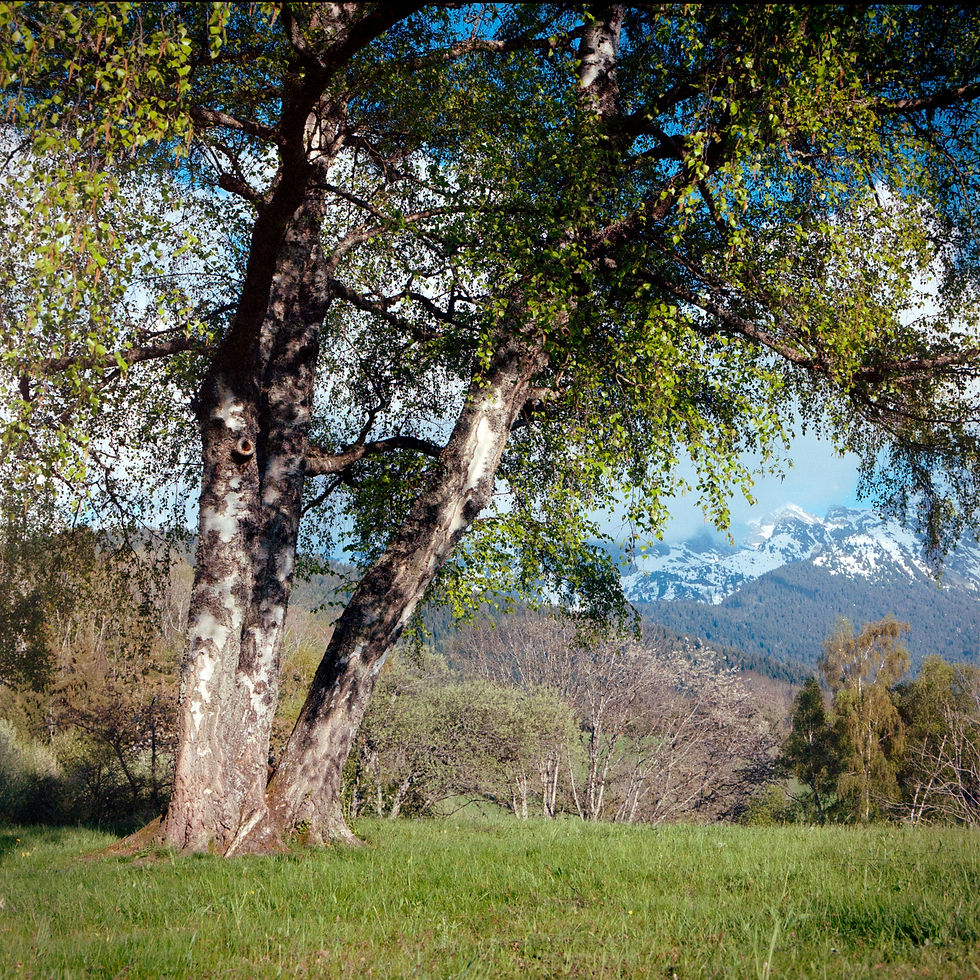
Photographing the spring–winter contrast
The Bronica is a modular system, which is part of the fun. You can swap film backs mid-roll thanks to a dark slide, so I brought two: a 6×6 back for square images, and a 6×4.5 back I use to crop out panoramas — a kind of X-Pan equivalent, with a mask in the focusing screen to compose for it.
I found my shot: a tree catching nice light, the mountains framed between its branches. The light on the tree stayed steady but the peaks kept slipping in and out of the clouds, so a lot of the day was simply waiting. While I waited, I worked the scene from other angles, that way I get to build a little series around a place rather than chase a single frame. The panorama I'm happiest about caught exactly what I came for: green leaves in the foreground, snow on the ridgeline behind. Spring and winter in one frame.


Gear & practical notes
For anyone wanting to try something similar: I don't own a dedicated light meter, so I meter with my smallest digital camera — a Lumix GM5. I set its ISO to match the film, frame up roughly the same scene, and read the settings it gives me. Then I zoom in on the shadows I want to keep and as long as they're no more than about two stops under, I'm happy. Negative film handles bright highlights forgivingly; it's the shadows you have to protect.
I loaded Portra 160 (a few years expired, so unfortunately giving a slight colour shift), and fired away!
Did it work?
That's the thing with film: I won't know for a while. The roll goes to the local lab to be developed, then I'll scan it at home. I think I loaded it right and fired clean — the open question is whether my metering held up, and whether the light was good enough for this subject. There's far less room for error than with digital. But I took my time, I shot with intention, and now I just have to hope it pays off.
We're seeing the results together. See you around!

Comments